

The Unresolved Gap and Reset System
Read it through. Work it through.
The Unresolved Gap and Reset System
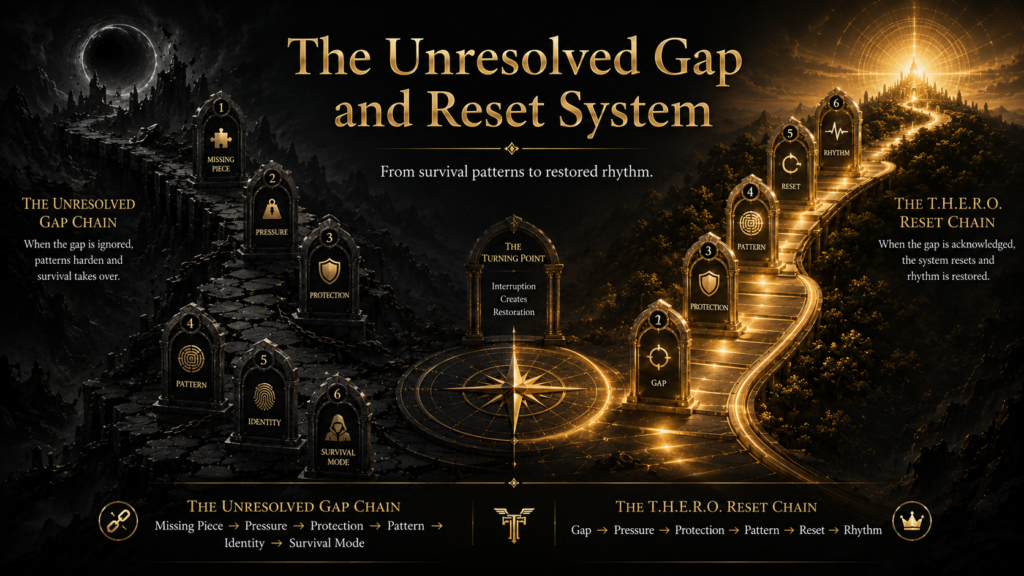
Identifying the Missing Piece, Recognizing the Pattern, and Restoring the Rhythm
Many repeated struggles are treated as character defects when they are actually the result of an unresolved gap.
A person may appear careless, resistant, unmotivated, irresponsible, aggressive, withdrawn, or undisciplined. Yet beneath the visible conduct there may be something missing that was never clearly taught, developed, supported, organized, or understood.
That missing piece creates pressure.
Pressure activates protection.
Protection becomes a repeated pattern.
The pattern begins to shape identity.
Eventually, the person may begin operating from survival rather than stewardship.
The T.H.E.R.O. framework reveals this movement through two connected chains:
The Unresolved Gap Chain
Missing Piece → Pressure → Protection → Pattern → Identity → Survival Mode
The T.H.E.R.O. Reset Chain
Gap → Pressure → Protection → Pattern → Reset → Rhythm
The first chain explains how an unresolved gap develops into a life-governing pattern.
The second chain shows where transformation can interrupt that movement.
Together with the Nine Gap Types, these frameworks provide a practical way to observe conduct without excusing harm, identify what is missing without reducing the person to a label, and build a responsible rhythm that can replace the survival pattern.
The Unresolved Gap Chain
Missing Piece → Pressure → Protection → Pattern → Identity → Survival Mode
An unresolved gap rarely remains isolated.
When the missing piece is not identified or supplied, it begins to affect how the person interprets pressure, protects themselves, repeats conduct, and eventually understands who they are.
The visible behavior is often the end of a much longer internal sequence.
Missing Piece
What Was Never Fully Received, Developed, or Established
The chain begins with something missing.
The missing piece may be information, instruction, skill, language, sequence, confidence, support, emotional regulation, identity, or rhythm.
A person cannot consistently operate with a capacity they have not yet developed.
They may have been told what to do without being shown how.
They may have received information without comprehension.
They may understand the goal but lack the steps.
They may possess the skill but lack confidence.
They may know the correct action but become emotionally overwhelmed under pressure.
They may begin well but lack the rhythm required to continue.
The missing piece answers:
What was required but never fully established?
A Gap Is Not Automatically an Excuse
Identifying a gap does not erase responsibility.
It creates a more accurate basis for responsibility.
The purpose is not to say:
“The conduct does not matter because something was missing.”
The purpose is to say:
“The conduct must be addressed, but the missing capacity must also be restored if the pattern is expected to change.”
Correction without restoration may temporarily stop behavior while leaving the underlying condition untouched.
Restoration without accountability may recognize the gap while allowing harmful conduct to continue.
The complete process requires both.
Pressure
What Happens When Life Demands What the Person Cannot Yet Supply
Pressure arises when the person encounters a situation requiring the missing capacity.
The demand may involve:
- Making a decision
- Completing a task
- Explaining an idea
- Receiving correction
- Managing emotion
- Maintaining a commitment
- Solving a problem
- Communicating under conflict
- Performing in public
- Assuming responsibility
- Adjusting to change
- Governing time, money, property, or relationships
When the person does not possess the necessary understanding, skill, language, sequence, confidence, support, regulation, identity, or rhythm, the demand creates strain.
Pressure answers:
What is being required that the person does not yet know how to supply?
Pressure Reveals the Gap
A gap may remain hidden until pressure appears.
A person may seem confident until they are required to perform.
They may seem emotionally stable until conflict begins.
They may appear organized until the number of responsibilities increases.
They may appear committed until the task requires repetition.
Pressure does not always create the weakness.
It often reveals where the unresolved weakness already exists.
The pressure point is therefore valuable information.
It identifies where support, instruction, structure, or development may be needed.
Protection
How the Person Attempts to Escape, Reduce, or Control the Pressure
When pressure reaches an unresolved gap, the person often develops a protection behavior.
Protection is the immediate strategy used to avoid exposure, failure, shame, fear, loss of control, rejection, confusion, or emotional discomfort.
Protection may appear as:
- Avoidance
- Withdrawal
- Defensiveness
- Blame
- Anger
- Lying
- Control
- Perfectionism
- Procrastination
- Humor
- Silence
- Overexplaining
- Discrediting
- People-pleasing
- Aggression
- Emotional shutdown
- Refusal
- Abandonment
The protection behavior may have once reduced immediate discomfort.
That temporary relief makes the behavior more likely to be repeated.
Protection answers:
What does the person do when the gap is exposed by pressure?
Protection Is Often Misidentified as Personality
A person who withdraws under pressure may be called distant.
A person who attacks when corrected may be called hostile.
A person who avoids tasks may be called lazy.
A person who lies when afraid may be called dishonest.
The conduct must be named accurately, but the investigation should continue.
Ask:
What pressure activated the behavior?
What gap did the behavior attempt to protect?
This does not remove accountability.
It prevents correction from stopping at the surface.
Pattern
When the Protection Behavior Becomes Repeated Conduct
A protection response becomes a pattern when it is repeatedly used in similar situations.
The sequence may begin to happen automatically:
The demand appears.
Pressure rises.
The person protects.
Temporary relief follows.
The original gap remains unresolved.
The same condition later returns.
The behavior becomes increasingly familiar.
Eventually, the person may no longer recognize that they are choosing the response.
It feels normal, necessary, or unavoidable.
Pattern answers:
What protection behavior has become the usual response?
Patterns Become Systems
A repeated pattern can begin influencing:
- Relationships
- Communication
- Parenting
- Work
- Education
- Finances
- Health
- Ministry
- Leadership
- Decision-making
- Family governance
- Estate preparation
- Self-perception
The person may organize their entire life around avoiding the pressure that reveals the gap.
They may choose relationships that never challenge them.
They may abandon opportunities before being evaluated.
They may resist systems that require accountability.
They may remain busy with minor tasks to avoid the responsibility that exposes their missing capacity.
The pattern becomes more than a behavior.
It becomes an operating structure.
Identity
When the Pattern Becomes a Statement About the Self
When a pattern continues long enough, the person may begin interpreting it as identity.
They move from saying:
“I struggle with this.”
to:
“This is who I am.”
Identity statements may include:
- “I am not smart.”
- “I am bad with money.”
- “I never finish anything.”
- “I cannot trust anyone.”
- “I am just an angry person.”
- “I do not belong.”
- “I am not a leader.”
- “I am not disciplined.”
- “Relationships never work for me.”
- “Nobody understands me.”
- “I cannot change.”
- “This is just how my family is.”
The pattern no longer feels like something the person does.
It feels like something the person is.
Identity answers:
What conclusion has the person formed about themselves because of the repeated pattern?
Identity Protects the Pattern
Once the behavior is connected to identity, correction may feel like an attack on the self.
The person may defend the pattern because abandoning it would require reconsidering who they believe themselves to be.
They may say:
“That is just me.”
“I have always been this way.”
“People need to accept me as I am.”
Acceptance of the person should not require acceptance of every harmful pattern.
The person has dignity beyond the behavior.
The pattern is learned, reinforced, and repeatable.
What has been learned can be examined.
What has been reinforced can be interrupted.
What has become rhythmic can be replaced by a healthier rhythm.
Survival Mode
When Protection Becomes the Governing Position
Survival mode is the final stage of the unresolved gap chain.
At this stage, the person’s primary concern is no longer growth, wisdom, stewardship, connection, or long-term responsibility.
The main concern becomes protection.
The person may constantly scan for:
- Threat
- Rejection
- Exposure
- Loss
- Criticism
- Failure
- Abandonment
- Disrespect
- Control
- Scarcity
- Emotional danger
Survival mode answers:
How does life look when protection becomes the primary governing system?
Survival Mode Narrows Perception
When a person operates from survival mode, they may have difficulty:
- Receiving correction
- Considering long-term consequences
- Trusting support
- Learning new skills
- Remaining present during discomfort
- Communicating clearly
- Accepting responsibility
- Taking healthy risks
- Distinguishing present conditions from past experiences
- Building stable relationships
- Establishing consistent rhythm
The person is not necessarily choosing growth and rejecting it.
They may be operating from a nervous, emotional, relational, or identity system organized around immediate protection.
The survival response may feel more urgent than the future consequence.
The Complete Unresolved Gap Chain
Missing Piece
Something required was not developed, understood, supported, or established.
Pressure
Life demanded the missing capacity.
Protection
The person developed a behavior to reduce the pressure.
Pattern
The protection behavior became a repeated response.
Identity
The repeated response became a statement about the self.
Survival Mode
Protection became the governing position.
The complete movement is:
Missing Piece → Pressure → Protection → Pattern → Identity → Survival Mode
This chain helps explain how a seemingly small unresolved gap can eventually influence an entire life.
The T.H.E.R.O. Reset Chain
Gap → Pressure → Protection → Pattern → Reset → Rhythm
The reset chain begins with the same early movement:
A gap exists.
Pressure reveals it.
Protection attempts to manage it.
The response becomes a pattern.
The difference comes before the pattern is allowed to harden into identity and survival mode.
The reset interrupts the chain.
The person does not deny what happened.
They observe it, identify the missing piece, restore the needed capacity, and establish a new repeated response.
Gap
Name the Missing Capacity
The reset begins by identifying the actual gap.
Do not begin with condemnation.
Do not begin by assuming that all resistance is rebellion or that every failure is laziness.
Ask:
What does this situation require?
Which capacity is missing or unstable?
Was the person clearly taught?
Do they understand the language?
Do they know the sequence?
Do they possess the skill?
Is emotional regulation available under pressure?
Do they have support?
Does the responsibility align with their identity?
Has a repeatable rhythm been established?
The more accurately the gap is named, the more precisely it can be addressed.
Pressure
Identify the Activation Point
The next step is to identify when the gap becomes pressured.
Ask:
- What demand activates the difficulty?
- What person, environment, task, or expectation is involved?
- What emotion arises?
- What consequence is feared?
- What does the person believe is about to happen?
- Is the pressure current, remembered, or both?
Pressure should be observed without exaggeration or minimization.
The purpose is to understand the point where the person begins losing access to their better position.
Protection
Recognize the Protective Response
The person must identify what they do when pressure appears.
Do they:
- Withdraw?
- Attack?
- Lie?
- Delay?
- Blame?
- Control?
- Shut down?
- Abandon the responsibility?
- Seek constant reassurance?
- Discredit the process?
- Discount the goal?
- Become emotionally overwhelmed?
Protection often happens quickly.
The earlier it is recognized, the easier it is to interrupt.
The goal is not to shame the protection response.
The goal is to understand what it attempts to accomplish and whether it still serves the person responsibly.
Pattern
Trace the Repeated Movement
The person then examines how often the sequence occurs.
Ask:
Where else does this happen?
What usually comes before it?
What conduct follows?
What temporary relief does the pattern provide?
What long-term cost does it create?
A pattern remains powerful when it is treated as an isolated event.
Tracing the repetition makes the structure visible.
Once the structure is visible, the reset can be designed.
Reset
Interrupt the Old Response and Restore the Missing Capacity
The reset is not merely stopping behavior.
It is a deliberate interruption followed by restoration.
A reset may include:
- Pausing before responding
- Regulating the body
- Naming the emotion
- Separating facts from assumptions
- Asking for clarification
- Receiving instruction
- Practicing a skill
- Establishing sequence
- Requesting support
- Correcting language
- Revising an identity statement
- Creating a smaller next step
- Setting a boundary
- Repairing harm
- Documenting the new decision
- Returning to direction
- Choosing the 5D Winning Position
- Applying O.X.3
The reset answers:
What must happen differently at the point where the old protection pattern normally takes control?
Reset Is a Responsible Return
A reset is not pretending the disruption never occurred.
It includes:
- Recognition
- Accountability
- Correction
- Restoration
- Re-entry
When harm has occurred, the reset may require apology, repair, restitution, clarification, or changed conduct.
When confusion caused the breakdown, the reset may require teaching.
When sequence was missing, the reset may require a step-by-step process.
When emotion overwhelmed the person, the reset may require regulation before communication.
The reset returns the person to a position capable of responsible operation.
Rhythm
Repeat the Restored Response Until It Becomes the New Normal
A reset creates an interruption.
Rhythm creates transformation.
One corrected action may prove that another response is possible, but repeated practice is required for the new response to become stable.
Rhythm may include:
- A daily practice
- A weekly review
- A communication routine
- A documented procedure
- A support meeting
- A study schedule
- A financial process
- A family governance rhythm
- A body regulation practice
- A decision checklist
- A morning or evening reset
- A repeated O.X.3 cycle
- A Daily Stewardship Assignment
Rhythm answers:
What repeated structure will preserve the reset under future pressure?
Rhythm Replaces Survival
The unresolved gap chain moves toward survival mode.
The reset chain moves toward stewardship.
Instead of the person becoming organized around avoidance, defense, and immediate relief, they begin building a rhythm of:
- Observation
- Responsibility
- Regulation
- Communication
- Preparation
- Practice
- Repair
- Consistency
- Review
The new rhythm does not erase the history.
It prevents history from remaining the only available operating system.
The Complete Reset Chain
Gap
Identify what is missing.
Pressure
Recognize what activates the difficulty.
Protection
Name the response used to escape or control the pressure.
Pattern
Trace how the response has been repeated.
Reset
Interrupt the pattern and restore the missing capacity.
Rhythm
Repeat the responsible response until it becomes stable.
The complete movement is:
Gap → Pressure → Protection → Pattern → Reset → Rhythm
The Two Chains Compared
| Unresolved Gap Chain | T.H.E.R.O. Reset Chain |
|---|---|
| Missing Piece | Gap |
| Pressure | Pressure |
| Protection | Protection |
| Pattern | Pattern |
| Identity | Reset |
| Survival Mode | Rhythm |
The two chains share the same beginning.
The difference is what happens after the pattern becomes visible.
Without intervention, the pattern may become identity and survival mode.
With a responsible reset, the pattern can be interrupted before it defines the person.
The new rhythm becomes evidence that another way of living is possible.
The Nine Gap Types
Understanding, Skill, Language, Sequence, Confidence, Support, Emotional Regulation, Identity, and Rhythm
The Nine Gap Types provide a practical diagnostic structure for identifying what may be missing beneath the visible conduct.
A person may experience more than one gap at the same time.
One gap may also create another.
For example, lack of understanding may weaken confidence.
Lack of sequence may create emotional pressure.
Lack of support may make rhythm difficult to maintain.
The purpose is not to label the person.
The purpose is to identify the capacity that must be strengthened.
1. Understanding Gap
When Information Has Been Received but Meaning Has Not Been Formed
An understanding gap exists when the person has heard, read, or encountered information but does not yet comprehend what it means, how the pieces connect, or why it matters.
They may be able to repeat instructions but remain unable to explain or apply them.
An understanding gap may appear as:
- Repeated confusion
- Misapplication of information
- Memorization without comprehension
- Difficulty explaining the concept
- Inability to adapt the lesson to a new situation
- Dependence on constant instruction
- Frustration when expected to act independently
The key question is:
Does the person understand the meaning, relationship, and purpose of what was taught?
Restoration May Require
- Simpler explanations
- Examples
- Visual models
- Questions that confirm comprehension
- Connection to prior experience
- Demonstration of cause and effect
- Breaking information into smaller parts
- Teaching the complete system rather than isolated facts
2. Skill Gap
When the Person Understands but Cannot Yet Perform
A skill gap exists when the person knows what should be done but has not yet developed the ability to do it consistently.
Knowing is not the same as performing.
A person may understand communication but lack the skill to express themselves under conflict.
They may understand budgeting but lack the practical skill to maintain records.
They may understand leadership but lack facilitation, delegation, or planning skills.
A skill gap may appear as:
- Poor execution
- Repeated mistakes
- Slow performance
- Avoidance of tasks
- Dependence on others
- Inconsistency
- Knowledge that does not become competent action
The key question is:
Has the person practiced the action enough to develop competence?
Restoration May Require
- Demonstration
- Guided practice
- Repetition
- Feedback
- Coaching
- Smaller exercises
- Correction without humiliation
- Progressive difficulty
- Opportunity to practice safely
3. Language Gap
When the Words, Terms, or Meanings Are Unclear
A language gap exists when the person does not understand the vocabulary, terminology, definitions, tone, symbols, or coded meaning used within a situation.
This may involve technical language, professional language, legal language, relational language, cultural language, spiritual language, or ordinary words used differently by different people.
A language gap may appear as:
- Misunderstanding instructions
- Confusion during conversation
- Silence caused by unfamiliar terminology
- Agreement without actual comprehension
- Conflict over words
- Difficulty expressing needs
- Misinterpretation of tone or intent
The key question is:
Do the people involved share the same meaning for the words being used?
Restoration May Require
- Defining terms
- Replacing complex language
- Confirming shared meaning
- Teaching vocabulary
- Allowing questions
- Avoiding unexplained jargon
- Creating glossaries or reference guides
- Distinguishing literal meaning from implied meaning
4. Sequence Gap
When the Person Knows the Goal but Not the Order
A sequence gap exists when the person understands what must ultimately happen but does not know what step comes first, next, or last.
A correct action performed in the wrong order may fail.
A sequence gap may appear as:
- Starting without preparation
- Skipping essential steps
- Becoming overwhelmed
- Repeating work
- Missing deadlines
- Acting before authority or consent is established
- Gathering information without knowing how to use it
- Abandoning the task because the whole process feels too large
The key question is:
Does the person know the correct order of operation?
Restoration May Require
- Step-by-step instructions
- Checklists
- Timelines
- Milestones
- Flowcharts
- Dependency mapping
- Clear beginning and ending points
- One next action at a time
5. Confidence Gap
When Capacity Exists but the Person Does Not Trust It
A confidence gap exists when the person possesses some knowledge or skill but doubts their ability to perform, decide, speak, lead, or continue.
Confidence may have been weakened by failure, criticism, lack of experience, comparison, humiliation, or prolonged dependence.
A confidence gap may appear as:
- Repeated reassurance seeking
- Hesitation
- Avoidance of visibility
- Fear of making decisions
- Giving authority away unnecessarily
- Abandoning work before evaluation
- Perfectionism
- Refusal to begin until certainty is guaranteed
The key question is:
Does the person trust themselves enough to responsibly use the capacity they possess?
Restoration May Require
- Small successful actions
- Accurate feedback
- Preparation
- Practice
- Recognition of progress
- Reduced task scale
- Permission to learn through correction
- Separation of mistake from identity
- Supportive accountability
6. Support Gap
When the Person Lacks the People, Resources, or Structure Needed to Continue
A support gap exists when the person is expected to carry a responsibility without sufficient assistance, tools, information, time, encouragement, access, or accountability.
Not every task should be carried alone.
A support gap may appear as:
- Burnout
- Incomplete work
- Isolation
- Repeated crisis
- Dependence on last-minute rescue
- Loss of motivation
- Avoidance caused by overwhelm
- Resentment from unequal responsibility
- Breakdown of family or team functions
The key question is:
What support is reasonably required for this responsibility to be sustained?
Restoration May Require
- Mentorship
- Delegation
- Shared responsibility
- Access to tools
- Financial or material resources
- Emotional support
- Clear roles
- Regular review
- Community
- Professional assistance
- Relief from unnecessary burdens
7. Emotional Regulation Gap
When the Person Cannot Maintain Access to Responsible Conduct Under Pressure
An emotional regulation gap exists when the person understands what should happen but loses access to that understanding when emotionally activated.
The internal charge becomes stronger than the available ability to pause, process, communicate, or choose.
An emotional regulation gap may appear as:
- Explosive anger
- Panic
- Shutdown
- Impulsive action
- Emotional flooding
- Inability to listen
- Harsh communication
- Withdrawal
- Freezing
- Difficulty returning after conflict
The key question is:
Can the person remain present and govern conduct when the emotional charge rises?
Restoration May Require
- Pausing
- Breath regulation
- Body awareness
- Grounding
- Naming the emotion
- Time before responding
- Safe communication structure
- Identifying triggers
- Repair practices
- Professional support where appropriate
- Repeated practice under manageable pressure
The central principle is:
Do not let the charge become conduct.
8. Identity Gap
When the Person Does Not Possess a Stable or Responsible Sense of Who They Are
An identity gap exists when the person’s self-understanding is unclear, externally controlled, fragmented, diminished, or shaped primarily by survival patterns.
The person may not know what role they hold, what responsibility belongs to them, what values govern them, or what kind of person they are becoming.
An identity gap may appear as:
- Dependence on external validation
- Changing position to gain acceptance
- Negative self-statements
- Lack of boundaries
- Resistance to responsibility
- Confusion about roles
- Repetition of family labels
- Acting from an inherited identity rather than a chosen and examined one
- Difficulty imagining a transformed self
The key question is:
What identity is governing the person’s choices, and is that identity aligned with truth, responsibility, and purpose?
Restoration May Require
- Examining identity statements
- Clarifying roles
- Reconnecting conduct to values
- Separating the person from the pattern
- Naming strengths and responsibilities
- Establishing direction
- Recognizing heritage, purpose, and stewardship
- Creating evidence through new conduct
- Replacing survival identity with responsible identity
9. Rhythm Gap
When the Person Can Begin but Cannot Sustain
A rhythm gap exists when the person possesses enough understanding, skill, language, sequence, confidence, support, regulation, and identity to begin, but lacks a repeatable structure for continuation.
The issue is not the first action.
It is the repeated action.
A rhythm gap may appear as:
- Strong beginnings followed by decline
- Inconsistent routines
- Repeated restarting
- Dependence on motivation
- Loss of progress after interruption
- Unfinished projects
- Irregular communication
- Crisis-driven action
- Failure to review and maintain systems
The key question is:
What repeated structure will allow the responsible action to continue?
Restoration May Require
- Daily or weekly practices
- Scheduling
- Accountability
- Environmental cues
- Reduced complexity
- Regular review
- Documentation
- Habit tracking
- Defined reset procedures
- A return process after interruption
- The Daily Stewardship Assignment
Rhythm converts isolated success into a stable way of life.
How the Nine Gaps Interact
The gap types should not always be treated as isolated categories.
A person may have:
- A language gap that creates an understanding gap
- An understanding gap that weakens confidence
- A confidence gap that produces avoidance
- An emotional regulation gap that disrupts communication
- A support gap that prevents rhythm
- A sequence gap that makes a simple task feel overwhelming
- An identity gap that causes the person to reject their own capacity
- A rhythm gap that prevents new skills from becoming stable
The diagnostic question is not merely:
Which gap is present?
It is also:
Which gap came first, and which gaps developed around it?
This keeps the restoration process focused on the actual root rather than only the most visible symptom.
One Gap at a Time
When multiple gaps are present, the person may feel completely overwhelmed.
The T.H.E.R.O. method begins with one gap at a time.
Identify the gap creating the greatest pressure or blocking the next necessary action.
Then:
- Observe the condition.
- Name the gap.
- Identify the pressure.
- Recognize the protection response.
- Trace the pattern.
- Design the reset.
- Establish the rhythm.
- Review the result.
Small, accurate restoration is more effective than broad, unfocused correction.
Applying O.X.3 to the Gap System
Observe
Identify the behavior, pressure, protection, pattern, and possible gap.
Organize
Separate facts from assumptions, determine the gap type, identify responsibility, and arrange the necessary support or sequence.
Operate
Complete one reset action and establish the next repeatable rhythm.
Then observe again.
O.X.3 turns the diagnostic framework into a practical process.
Applying the 5D Winning Position
Direction
Identify the restored condition being built.
Determination
Remain engaged when the pattern resists interruption.
Dedication
Practice the new skill, sequence, language, or response.
Devotion
Protect the deeper purpose of the transformation.
Discipline
Repeat the reset until it becomes rhythm.
The 5D Winning Position helps the person remain in the restoration process long enough for the new rhythm to stabilize.
Gap Reflection
Choose one repeated difficulty.
Missing Piece
What capacity may be missing?
Pressure
When does the difficulty become activated?
Protection
What do I do to escape, reduce, or control the pressure?
Pattern
How has this response repeated?
Identity
What have I begun believing about myself because of the pattern?
Survival Mode
How has protection begun governing my choices?
Then begin the reset.
Gap
Which of the Nine Gap Types is present?
Reset
What one action would interrupt the usual response?
Rhythm
What repeated practice would make the new response stable?
The Unresolved Gap Principle
A repeated behavior may be visible long before the missing capacity is understood.
Do not excuse the conduct.
Do not reduce the person to the conduct.
Observe what is missing.
Identify what creates pressure.
Recognize the protection behavior.
Trace the repeated pattern.
Interrupt the movement before it becomes identity and survival mode.
Restore the missing capacity.
Then repeat the responsible response until it becomes rhythm.
From Survival to Stewardship
The unresolved chain moves toward survival:
Missing Piece → Pressure → Protection → Pattern → Identity → Survival Mode
The T.H.E.R.O. chain moves toward stewardship:
Gap → Pressure → Protection → Pattern → Reset → Rhythm
Transformation occurs when the person no longer lives only to protect themselves from the pressure created by what is missing.
They learn to observe the gap, receive what was absent, practice a new response, and establish a rhythm capable of carrying responsibility.
The goal is not perfection.
The goal is a better governing system.
One gap identified.
One protection behavior interrupted.
One pattern reset.
One responsible rhythm established.
That is how survival begins to become stewardship.