
Will Power and Ill Power
Read it through. Work it through.
Do Not Let the Charge Become Conduct
ILL — When the Condition Governs
An obstructed operating condition with too much governing influence. Its downward movement:
- Denial
- Doubt
- Discredit
- Dismal
- Demonized
WILL — When Wisdom Governs
Ordered direction under wisdom, strengthened through:
- Discipline
- Devotion
- Dedication
- Determination
- Direction
Observe → Discern → Select → Decide
Will Power and Ill Power
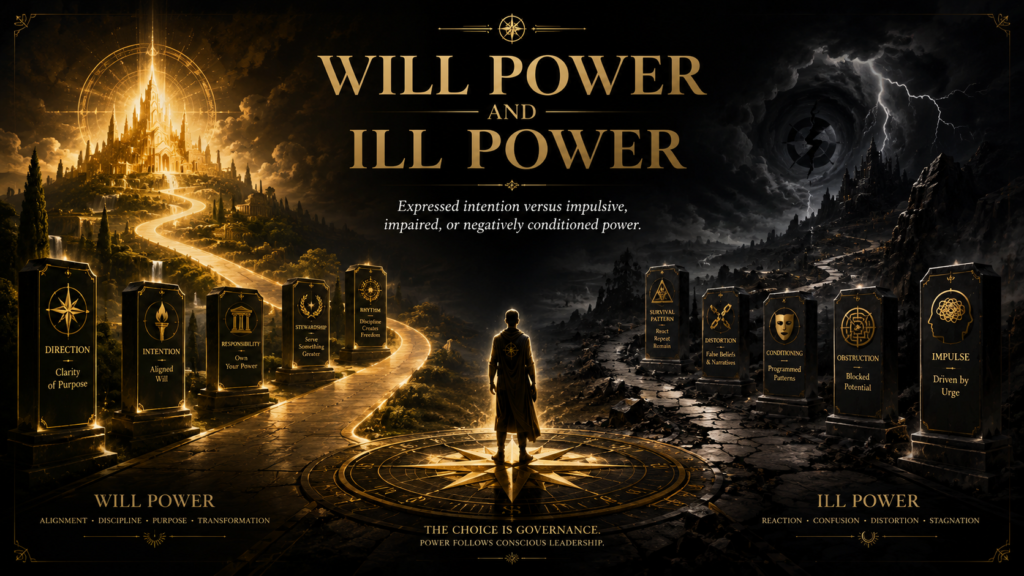
Expressed Intention Versus Impulsive, Impeded, and Negatively Conditioned Power
Power is the capacity to produce movement, influence conduct, and create an outcome.
Every person possesses power. It appears through thought, speech, emotion, attention, decision, behavior, habit, and relationship.
The central question is not whether a person has power.
The question is:
What is governing the power they possess?
Power may be consciously directed toward a responsible purpose, or it may be driven by fear, impulse, obstruction, unresolved pressure, and negative conditioning.
T.H.E.R.O. distinguishes these two movements as:
Will Power
Expressed intention directed through responsible conduct.
Ill Power
Power moved through impulse, impediment, negative conditioning, and unresolved internal pressure.
Will Power builds according to purpose.
Ill Power reacts according to pressure.
Will Power moves from direction into disciplined expression.
Ill Power moves from an unresolved charge into conduct.
The purpose of this framework is not to divide people into good and bad categories. The same person may operate through Will Power in one area and Ill Power in another.
The work is to observe which power is active, identify what governs it, and restore the ability to choose before power becomes conduct.
Power Is Always Expressing
Power is not limited to dramatic action.
A person expresses power when they:
- Speak
- Remain silent
- Begin
- Delay
- Agree
- Refuse
- Create
- Destroy
- Encourage
- Discredit
- Protect
- Control
- Withdraw
- Forgive
- Retaliate
- Complete
- Abandon
- Establish a boundary
- Ignore a responsibility
Even inaction may exercise power.
Silence can create peace, but silence can also withhold necessary truth.
A refusal can protect a proper boundary, but refusal can also become resistance to responsibility.
Anger can signal that something matters, but unmanaged anger can become harmful conduct.
The visible action alone does not reveal the nature of the power.
The deeper question is:
What position, intention, pressure, or conditioning is moving through the action?
Will Power
Power Directed by Conscious and Expressed Intention
Will Power is the capacity to identify a responsible intention and carry it into conduct.
It does not mean forcing oneself through every obstacle.
It means bringing thought, desire, decision, responsibility, and action into alignment.
Will Power begins with an expressed inner declaration:
“This is what I intend to build, protect, correct, or become.”
That intention is then tested through action.
True Will Power is not proved by what a person says they want. It is demonstrated by the conduct they repeatedly choose.
Will Power answers:
What do I intend?
Why does it matter?
What responsible action expresses that intention?
What rhythm will sustain it?
Will Power Is Expressed Desire
A desire remains internal until it is expressed through a decision, word, action, boundary, practice, or commitment.
A person may desire peace while repeatedly participating in disorder.
They may desire transformation while protecting the pattern that prevents it.
They may desire a stable family while refusing the responsibilities required to build one.
Will Power closes the distance between the declared desire and the demonstrated conduct.
It moves through this sequence:
Desire → Direction → Decision → Expression → Discipline
Desire identifies what is wanted.
Direction gives the desire a destination.
Decision establishes commitment.
Expression carries commitment into action.
Discipline repeats the action until it becomes rhythm.
The Characteristics of Will Power
Will Power Is Conscious
The person is aware of what they are choosing and why.
They do not merely react to the strongest emotion or immediate pressure.
They observe the internal charge, consider the consequences, and choose a response aligned with the intended outcome.
Will Power Is Directed
Will Power has a destination.
It is guided by clear purpose rather than scattered effort.
Direction allows the person to measure whether a choice supports or opposes what they intend to build.
Will Power Is Responsible
Will Power accepts accountability for conduct and consequence.
It does not claim good intention while ignoring harmful impact.
The person remains willing to correct the method when the expression of the intention produces disorder.
Will Power Is Relational
Responsible power considers how conduct affects other people.
It respects dignity, boundaries, consent, role, jurisdiction, responsibility, and shared consequences.
Will Power does not require domination.
It seeks an expression capable of preserving both purpose and proper relationship.
Will Power Is Rhythmic
Will Power is not a single emotional surge.
It becomes reliable through repeated practice.
The intention must survive changing moods, pressure, delay, disappointment, and distraction.
Will Power and the 5D Winning Position
Will Power develops through the 5D Winning Position:
Direction
The person identifies what they intend to produce.
Determination
They decide not to abandon the intention when resistance appears.
Dedication
They give time, labor, attention, and preparation to the work.
Devotion
They protect the meaning and integrity of the intention.
Discipline
They repeatedly express the intention through responsible conduct.
The 5D Winning Position converts Will Power from a temporary feeling into a governed way of operating.
Ill Power
Power Distorted by Impulse, Impediment, and Negative Conditioning
Ill Power is not the absence of power.
It is power moving through an unhealthy or disordered channel.
A person operating through Ill Power may still be forceful, productive, persuasive, intelligent, determined, or influential. The concern is not the amount of power they possess.
The concern is what governs that power and what outcome it produces.
Ill Power may be:
- Impulsive
- Impeded
- Implied
- Conditioned by negative identity
- Driven by unresolved gaps
- Activated by emotional pressure
- Expressed through protection behavior
Ill Power answers:
What is moving me when I am not consciously governing myself?
Impulsive Power
Acting Before Observation, Organization, and Position
Impulsive power moves quickly from charge to conduct.
The person feels an emotion, urge, fear, desire, attraction, frustration, or threat and immediately acts.
There is little space between activation and expression.
Impulsive power may appear as:
- Speaking before understanding
- Spending without consideration
- Agreeing without evaluating
- Attacking when corrected
- Leaving when discomfort appears
- Making promises during excitement
- Sending messages during anger
- Seeking immediate pleasure despite long-term consequences
- Acting to relieve pressure rather than resolve the issue
The impulse may be strong, but strength does not make it wise.
The central danger is:
The charge becomes conduct before stewardship can intervene.
The Impulse Is Information, Not Instruction
An impulse reveals that something has been activated.
It may reveal:
- Desire
- Fear
- Anger
- Grief
- Attraction
- Scarcity
- Shame
- Excitement
- An unresolved gap
- A learned protection response
The impulse should be observed.
It should not automatically be obeyed.
A person can say:
“I feel the urge to act, but I have not yet determined whether that action serves my direction.”
That pause begins the restoration of Will Power.
Impeded Power
When Intention Exists but Cannot Move Freely into Conduct
Impeded power occurs when the person has an intention but something obstructs its expression.
The obstruction may include:
- Fear
- Confusion
- Shame
- Lack of confidence
- Lack of skill
- Lack of sequence
- Emotional overwhelm
- Negative identity
- External control
- Lack of support
- Trauma-related protection
- Repeated failure
- Conflicting responsibilities
- An unstable rhythm
A person may sincerely want to act but remain unable to move consistently.
They may say:
- “I know what I need to do, but I cannot begin.”
- “I understand it, but I freeze.”
- “I keep stopping myself.”
- “I make progress, then disappear.”
- “I want to speak, but I shut down.”
- “I know I am capable, but I do not trust myself.”
Impeded power answers:
What is obstructing the path between intention and expression?
An Impediment Is Not Always Laziness
Visible inactivity may be misidentified as lack of desire.
The person may possess genuine intention but lack a necessary capacity.
The obstruction may be one of the Nine Gap Types:
- Understanding
- Skill
- Language
- Sequence
- Confidence
- Support
- Emotional Regulation
- Identity
- Rhythm
The correct response depends on the actual impediment.
A confidence gap cannot be repaired only by giving more information.
A sequence gap cannot be corrected merely by demanding more effort.
An emotional regulation gap cannot always be solved by telling the person to calm down.
Impeded power must be diagnosed before it can be restored.
Implied Power
Power Governed by Assumption, Suggestion, and Unspoken Meaning
Implied power operates through what is assumed rather than clearly expressed.
The person may act according to:
- What they think someone meant
- What they believe others expect
- What was suggested but never confirmed
- What family conditioning taught without explanation
- What social pressure presents as normal
- What fear predicts will happen
- What earlier experiences imply about the present
Implied power can govern conduct without the person recognizing the source.
A child may learn that speaking creates punishment and later remain silent in adult relationships.
A family may imply that planning for death is disloyal or fearful, leading generations to avoid estate preparation.
A person may interpret delayed communication as rejection because earlier abandonment taught that absence means loss.
The present action is then moved by an implied meaning carried from the past.
Expressed Intention Versus Implied Intention
Will Power requires the intention to become clear.
Instead of relying upon implication, the person asks:
- What was actually said?
- What was actually agreed?
- What is being assumed?
- What expectation needs to be expressed?
- What meaning requires clarification?
- What inherited belief is governing this decision?
Implied meaning becomes especially dangerous when it is treated as confirmed fact.
Clear expression restores choice.
Negatively Conditioned Power
When Repeated Messages and Experiences Train Power Toward Defeat
Conditioned power develops through repetition.
A person repeatedly receives messages about themselves, other people, relationships, responsibility, money, authority, love, or possibility.
Over time, those messages become internal expectations.
Negative conditioning may produce beliefs such as:
- “I am not capable.”
- “People always leave.”
- “Nobody can be trusted.”
- “Money always disappears.”
- “Love requires suffering.”
- “Authority is always harmful.”
- “I never finish.”
- “Success is not for people like me.”
- “My voice does not matter.”
- “There is no point preparing.”
These statements begin influencing conduct before the person consciously evaluates them.
Power still moves, but it moves toward protecting and proving the conditioned identity.
Negative Conditioning Creates Self-Confirming Conduct
A person who believes they will fail may delay preparation, avoid support, and abandon the task early.
The result appears to confirm the belief.
A person who believes everyone leaves may become controlling, suspicious, or emotionally unavailable.
The relationship weakens, and the separation appears to confirm the belief.
A person who believes their voice does not matter may remain silent until resentment becomes anger.
The conflict then appears to prove that speaking is unsafe.
Negative conditioning creates a cycle:
Conditioned Belief → Protective Conduct → Consequence → Reinforced Belief
The person may believe life is repeatedly proving the identity, while the identity is also influencing the conduct that helps produce the result.
Ill Power and the Unresolved Gap Chain
Ill Power often develops through the Unresolved Gap Chain:
Missing Piece → Pressure → Protection → Pattern → Identity → Survival Mode
A missing capacity creates pressure.
Pressure activates an impulsive or protective response.
The response becomes a pattern.
The pattern becomes an identity.
The identity begins governing power from survival mode.
At that point, the person may no longer ask:
“What do I intend?”
They operate from:
“What must I avoid, defend against, control, or escape?”
This is power governed by protection rather than purpose.
The Expressions of Ill Power
Ill Power may appear through:
Negative Self-Talk
The person repeatedly speaks limitation, condemnation, fear, or defeat over themselves.
Negative Identity
A temporary struggle becomes a permanent statement about who the person is.
Impulsive Conduct
Emotion and desire move directly into action without observation or responsibility.
Obstructed Expression
The person wants to act but repeatedly freezes, delays, withdraws, or abandons.
Protection Behaviors
Blame, anger, lying, control, avoidance, perfectionism, silence, or withdrawal are used to escape pressure.
Misused Influence
Power is used to dominate, manipulate, humiliate, discredit, or remove another person’s responsible choice.
Disorderly Rhythm
The person acts only in crisis, according to mood, or when pressure becomes unbearable.
Will Power Does Not Mean Force
Will Power is often misunderstood as the ability to push harder.
This can turn self-governance into self-violence.
Responsible Will Power does not ignore exhaustion, grief, limitations, missing skills, or the need for support.
It does not demand constant productivity.
It does not treat rest as failure.
It does not force an operation when the position is unstable.
Will Power may express itself by:
- Continuing
- Pausing
- Asking for help
- Changing the method
- Reducing the scale
- Establishing a boundary
- Releasing a false obligation
- Receiving instruction
- Repairing harm
- Resting before returning
- Refusing an unhealthy impulse
The measure is not force.
The measure is alignment between intention, responsibility, conduct, and consequence.
The Charge and the Conduct
Every emotion carries energy.
Anger may create energy to confront injustice.
Fear may create energy to seek safety.
Grief may create energy to honor what was lost.
Desire may create energy to pursue connection or purpose.
The energy is the charge.
The action is the conduct.
Will Power governs the relationship between them.
Ill Power collapses the distance between them.
The central principle is:
Do not let the charge become conduct before the charge has been observed, understood, and positioned.
This does not mean suppressing the charge.
It means translating it.
Ask:
- What is this feeling communicating?
- What gap or value has been activated?
- What action am I being pushed toward?
- What outcome would that action produce?
- What responsible expression would honor the truth without causing unnecessary harm?
Will Power Through O.X.3
O.X.3 provides the practical process for restoring Will Power.
Observe
Recognize the impulse, obstruction, conditioning, gap, and intended outcome.
Ask:
- What am I feeling?
- What do I feel pushed to do?
- What am I avoiding?
- What belief is influencing me?
- What do I actually intend?
Organize
Arrange the facts, emotions, responsibilities, capacities, boundaries, and sequence.
Ask:
- What is true?
- What is assumed?
- What belongs to the past?
- What is my responsibility now?
- What support or skill is needed?
- What action aligns with my direction?
Operate
Express the intention through one clear, accountable action.
The movement becomes:
Observe the Power → Organize the Intention → Operate Responsibly
Resetting Ill Power
Ill Power is not overcome through self-condemnation.
Condemnation often increases the pressure that produced the protective pattern.
The reset requires observation, accountability, restoration, and practice.
Step One: Name the Intention
What do you truly want to build, protect, correct, or become?
Step Two: Identify the Ill Expression
How is your present conduct opposing or distorting that intention?
Step Three: Locate the Pressure
What demand, fear, memory, conflict, or uncertainty activates the response?
Step Four: Identify the Gap
Which missing capacity is contributing to the reaction?
Step Five: Interrupt the Conduct
Pause, regulate, clarify, delay the reaction, or step away from the immediate impulse.
Step Six: Choose the Will Expression
Determine the smallest responsible action that expresses the stated intention.
Step Seven: Establish Rhythm
Repeat the responsible expression until it becomes more available under pressure.
From Ill Power to Will Power
The restorative movement may be expressed as:
Impulse → Observation
Impediment → Identification
Negative Conditioning → Examination
Protection → Reset
Intention → Expression
Expression → Rhythm
The person does not eliminate power.
They redirect it.
The same energy previously used to avoid responsibility can be used to seek understanding.
The same voice used to discredit the self can be used to establish direction.
The same determination used to defend a harmful pattern can be redirected toward transformation.
The same sensitivity used to scan for danger can become discernment when placed under responsible governance.
Will Power in Personal Transformation
Will Power appears when the person:
- States a clear direction
- Accepts responsibility without self-condemnation
- Identifies the missing capacity
- Practices a replacement response
- Returns after interruption
- Refuses to make the pattern their identity
- Establishes a sustainable rhythm
Ill Power appears when the person:
- Reacts to discomfort without observation
- Repeats negative identity statements
- Avoids the very practice required for change
- Discredits the process
- Uses pressure as proof that transformation is impossible
- Discounts themselves after failure
Will Power in Relationships
Will Power expresses love through honesty, loyalty, respect, trust, responsibility, acceptance, grace, and mercy.
It allows a person to communicate the intention rather than expecting others to understand what remains implied.
Will Power says:
- “This is what I feel.”
- “This is what I understood.”
- “This is what I need to clarify.”
- “This is the boundary I must establish.”
- “This is the harm I caused.”
- “This is how I intend to repair it.”
Ill Power may express itself through manipulation, silent punishment, impulsive accusation, control, withdrawal, lying, discrediting, demonizing, or discounting the relationship.
Will Power in Family and Legacy
Will Power allows a family to express its intention through preparation.
A family may say it values legacy, but Will Power requires that value to become:
- Education
- Planning
- Defined roles
- Property stewardship
- Written instruments
- Records
- Successor preparation
- Family meetings
- Responsible transfer
- Repeated governance rhythms
Ill Power appears when fear, denial, negative conditioning, confusion, or avoidance prevents the family from preparing.
The unexpressed intention remains a hope rather than a governing system.
Will Power in Mission and Work
Will Power turns vision into operation.
It gives the mission:
- Direction
- Structure
- Sequence
- Labor
- Accountability
- Documentation
- Review
- Discipline
Ill Power may appear as overactivity without direction, impulsive expansion, avoidance of difficult work, perfectionism, refusal of correction, or abandoning the mission when results are delayed.
The goal is not constant motion.
The goal is directed and sustainable movement.
Will Power and the Inner Kingdom
The Inner Kingdom is the realm in which power is first governed.
Before power becomes speech, conduct, policy, relationship, or institution, it moves through the internal kingdom of:
- Thought
- Emotion
- Desire
- Memory
- Belief
- Imagination
- Identity
- Will
Where the Inner Kingdom lacks governance, outer conduct becomes vulnerable to impulse and conditioning.
Will Power is the disciplined expression of an internally governed kingdom.
Ill Power is the external evidence of power that has not yet been properly observed, organized, healed, or directed.
Will Power Reflection
Choose one current responsibility, goal, or relationship.
Intention
What do I say I want?
Expression
What conduct currently demonstrates that intention?
Impulse
What do I feel pushed to do under pressure?
Impediment
What prevents me from expressing my intention responsibly?
Conditioning
What repeated belief or identity statement influences my conduct?
Gap
Which missing capacity contributes to the problem?
Reset
What action will interrupt the Ill Power response?
Rhythm
What repeated practice will strengthen the Will Power expression?
Then ask:
Does my conduct express my intention, or does it express my conditioning?
The Will and Ill Power Principle
Will Power is intention consciously expressed through responsible conduct.
Ill Power is power moved by impulse, obstruction, unresolved pressure, or negative conditioning.
Both contain energy.
Only one is properly governed.
The work is not to destroy the power within the person.
The work is to restore direction, remove unnecessary impediments, examine conditioning, regulate the charge, and create a responsible channel through which the power can be expressed.
Govern the Power Before It Governs You
Pause before the impulse becomes conduct.
Identify what is obstructing the intention.
Examine what has been negatively conditioned.
Name the unresolved gap.
Return to direction.
Organize the responsible expression.
Then operate through one clear action.
Power without governance becomes reaction.
Intention without expression remains potential.
Expression without responsibility creates disorder.
Will Power brings power, purpose, responsibility, and conduct into alignment.
That is how impulse becomes intention, obstruction becomes movement, conditioning becomes conscious choice, and power becomes stewardship.