

O.X.3 — The Stewardship Process
Read it through. Work it through.
O.X.3: The Stewardship Process
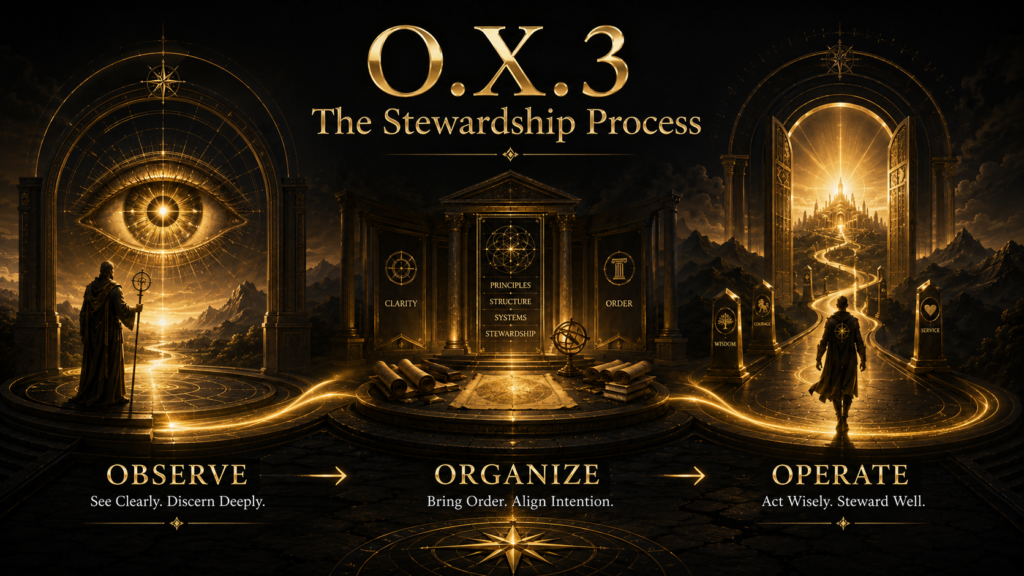
Observe → Organize → Operate
Transformation does not begin with immediate action.
It begins with accurate observation.
Many people operate too quickly. They react before they understand, decide before they organize, and act before they establish the proper position. This creates unnecessary mistakes, repeated patterns, emotional conduct, and unfinished work.
O.X.3 provides a simple stewardship process:
Observe → Organize → Operate
The process slows impulsive movement without creating paralysis.
It helps a person see clearly, arrange what has been discovered, and then act from order rather than pressure.
O.X.3 may be applied to personal transformation, relationships, family governance, business, ministry, education, estate preparation, conflict resolution, and daily responsibility.
The principle is simple:
Do not operate on what has not been observed and organized.
O — Observe
See What Is Present Before Attempting to Change It
Observation is the first act of stewardship.
To observe is to pause long enough to recognize what is actually happening.
This includes the visible facts, the internal response, the surrounding conditions, the people involved, the missing information, and the patterns that may be influencing the situation.
Observation is not passive.
It is active attention without premature judgment.
A person who does not observe clearly may react to an assumption, defend against something that was never intended, or attempt to solve the wrong problem.
Observation asks:
What is happening?
What am I feeling?
What facts are present?
What am I assuming?
What pattern is being repeated?
What may be missing?
The purpose is not to avoid action.
The purpose is to make sure the action responds to reality.
Observe the Situation
Begin with what can be confirmed.
What happened?
Who was involved?
What was said or done?
What is the present condition?
What responsibility is affected?
Separate what is known from what is believed.
Facts should not be confused with interpretations.
For example:
Fact: A message was not answered.
Interpretation: The person is ignoring me.
Fact: A deadline was missed.
Interpretation: The person does not care.
Fact: I feel pressure.
Interpretation: I must act immediately.
Observation allows the person to recognize the difference.
Observe the Internal Charge
Every situation creates an internal response.
That response may include anger, fear, shame, excitement, disappointment, confusion, attraction, defensiveness, urgency, or grief.
The charge is real, but it is not yet instruction.
A strong feeling does not automatically reveal the correct action.
Observe the charge before it becomes conduct.
Ask:
What has been activated in me?
Is this response connected only to the present situation?
Has an unresolved gap or earlier experience been touched?
What action do I feel pushed to take?
Would that action create order or increase disorder?
The goal is not to suppress emotion.
The goal is to prevent emotion from operating without stewardship.
Observe the Pattern
Many situations are not isolated events.
They belong to a pattern.
A person may repeatedly withdraw when corrected, overpromise when excited, become defensive under pressure, delay important work, or discount a mission when progress becomes difficult.
Observation should therefore examine both the present moment and the repeated movement.
Ask:
Has this happened before?
What usually comes next?
What do I typically do under this kind of pressure?
What result does that conduct normally produce?
Patterns reveal where stewardship is needed most.
Observe the Missing Piece
Not every problem is caused by unwillingness.
Some problems are produced by a missing piece.
The missing piece may be:
- Understanding
- Skill
- Language
- Sequence
- Confidence
- Support
- Emotional regulation
- Identity
- Rhythm
A person may appear resistant when they do not understand.
They may appear careless when they lack sequence.
They may appear undisciplined when they have never established a workable rhythm.
Observation helps identify the actual gap before blame is assigned.
The Discipline of Observation
Clear observation requires:
- Pausing before reacting
- Listening before answering
- Separating facts from assumptions
- Recognizing internal pressure
- Identifying repeated patterns
- Looking for the unresolved gap
- Refusing to exaggerate or minimize
- Allowing reality to correct the preferred story
Observation says:
“I will see what is present before deciding what it means.”
X — The Point of Crossing
The “X” in O.X.3 represents the point of intersection.
It is the moment where observation must become organization.
At this crossing point, multiple elements meet:
- Facts and feelings
- Past patterns and present conditions
- Problems and possible solutions
- Desire and responsibility
- Individual needs and shared consequences
- Internal position and external operation
The X is where the person pauses before moving forward.
It asks:
What must be arranged before I act?
This prevents the person from carrying confusion directly into operation.
The X is not a separate stage from the three actions. It represents the transition point where observation is converted into order.
O — Organize
Put What You Observed into Proper Order
Organization is the second act of stewardship.
Once the situation has been observed, the information must be arranged.
Without organization, a person may recognize many facts but remain unable to determine what matters first.
Organization creates sequence.
It separates the urgent from the important, the controllable from the uncontrollable, the present responsibility from the surrounding noise, and the next step from the entire mission.
Organization asks:
What belongs together?
What must happen first?
What is my responsibility?
What requires more information?
What resources are available?
What must be corrected, delegated, delayed, or removed?
Organization transforms observation into a workable position.
Organize the Facts
Determine what has been confirmed.
Remove exaggeration, emotional conclusions, and unsupported assumptions.
Write down or clearly identify:
- What occurred
- What remains unresolved
- What has already been attempted
- What information is missing
- What consequences are present
- What decisions must be made
This creates a reliable foundation for action.
Organize the Responsibilities
Not every part of a situation belongs to you.
Healthy stewardship requires distinguishing between:
- What you caused
- What you contributed
- What you can correct
- What belongs to another person
- What requires shared agreement
- What cannot currently be controlled
Taking responsibility for everything creates exhaustion and resentment.
Taking responsibility for nothing creates disorder.
Organization establishes the proper boundary.
Ask:
What is mine to govern?
What must be requested from others?
What must be released because it is outside my authority?
Organize the Priorities
Every issue cannot be handled at once.
Determine what must be addressed first.
A useful order is:
- Safety and immediate harm
- Truth and accurate understanding
- Responsibility and correction
- Structure and support
- Long-term rhythm and prevention
The loudest issue is not always the most important issue.
Pressure often pushes people toward what feels urgent while deeper structural problems remain untouched.
Organization restores sequence.
Organize the Resources
Identify what is available to support the operation.
Resources may include:
- Knowledge
- Time
- Money
- Tools
- Documents
- Trusted people
- Professional guidance
- Existing systems
- Family or team roles
- Previous experience
- Spiritual practice
- Rest and recovery
A person may feel powerless because the available resources have not been identified or arranged.
Organization reveals capacity.
Organize the Roles
When more than one person is involved, unclear roles create confusion.
Determine:
- Who has authority to decide
- Who is responsible for execution
- Who must be consulted
- Who needs to be informed
- Who is affected by the outcome
- Who should not be involved
This is especially important in families, ministries, businesses, organizations, and estate governance.
A task without an owner becomes a delay.
Authority without accountability becomes disorder.
Responsibility without authority becomes frustration.
Organization aligns the role with the duty.
Organize the Sequence
A correct action performed in the wrong order can still produce failure.
Before operating, determine the sequence.
Ask:
What must be completed before the next step becomes possible?
What dependency exists?
What decision unlocks the process?
What preparation is required?
What should not happen yet?
Sequence protects energy from being wasted.
Organize the Internal Position
Organization is not limited to external tasks.
The person must also arrange their internal position.
Before acting, ask:
Am I operating from direction or doubt?
Am I responding to reality or protecting a pattern?
Am I calm enough to communicate clearly?
Am I prepared to accept responsibility for the result?
Does my intended action reflect the House of Love, the 5D Winning Position, and the Ninth Point?
An organized plan carried by a disorganized internal position may still become harmful conduct.
The Discipline of Organization
Clear organization requires:
- Defining the actual issue
- Separating responsibilities
- Establishing priorities
- Assigning roles
- Identifying resources
- Creating sequence
- Setting boundaries
- Preparing the internal position
- Choosing the next responsible action
Organization says:
“I will place what I observed into an order that can be responsibly governed.”
O — Operate
Act from Position, Order, and Responsibility
Operation is the third act of stewardship.
To operate is to carry the organized decision into conduct.
This is where understanding becomes application.
Operation may involve speaking, writing, correcting, creating, repairing, documenting, delegating, setting a boundary, completing a task, changing a routine, or choosing not to act until a required condition is met.
Operation asks:
What is the next responsible action?
Not the most dramatic action.
Not the action that immediately relieves pressure.
Not the action that proves a point.
The next responsible action.
Operate with Clarity
The action should be specific.
Instead of:
“I need to fix my life.”
Operate with:
“I will complete the first section of the assessment tonight.”
Instead of:
“We need better communication.”
Operate with:
“We will meet for thirty minutes and discuss one issue without interruption.”
Instead of:
“I need to organize the estate.”
Operate with:
“I will gather the current property, account, beneficiary, and fiduciary records.”
Clarity makes action measurable.
Operate within Authority
A person should not operate beyond their proper role.
Before acting, confirm:
- Do I have the authority to make this decision?
- Does another person’s consent matter?
- Am I acting for myself or attempting to control someone else?
- Does the role require documentation?
- Will this action affect rights, property, trust, safety, or shared responsibility?
Responsible operation respects jurisdiction, role, and boundary.
Operate without Letting the Charge Become Conduct
A plan may be correct, but the manner of execution may still be harmful.
The person must govern tone, timing, language, and intensity.
A boundary can be established without humiliation.
A correction can be delivered without contempt.
A disagreement can be expressed without demonizing.
A decision can be enforced without unnecessary aggression.
Operation should reflect stewardship, not emotional discharge.
Operate at the Proper Scale
Many people fail because they attempt an action too large to sustain.
Responsible operation often begins with the smallest meaningful step.
The action should be large enough to create movement but small enough to complete.
Examples include:
- Making one call
- Completing one form
- Reading one section
- Correcting one misunderstanding
- Creating one folder
- Scheduling one meeting
- Removing one distraction
- Establishing one daily practice
- Documenting one decision
Small responsible action creates evidence of movement.
Evidence strengthens confidence.
Confidence supports rhythm.
Operate with Documentation
Where responsibility affects family, ministry, business, property, finances, education, or long-term governance, the operation should be recorded.
Documentation may include:
- Notes
- Decisions
- Agreements
- Policies
- Minutes
- Assignments
- Deadlines
- Receipts
- Instruments
- Reports
- Follow-up records
Memory is not a governance system.
Documentation preserves continuity, accountability, and institutional knowledge.
Operate with Review
Operation is not the end of the process.
After action, observe the result.
Ask:
What changed?
What worked?
What created resistance?
What remains unresolved?
What must be reorganized?
What should be repeated, corrected, or discontinued?
The cycle then begins again:
Observe → Organize → Operate
O.X.3 is not a one-time method.
It is a repeating stewardship rhythm.
The O.X.3 Cycle
Observe
See the reality, the charge, the pattern, and the missing piece.
Organize
Arrange the facts, responsibilities, roles, priorities, resources, and sequence.
Operate
Take the next responsible action from the proper position.
Then observe the result.
This creates a living cycle:
Observe → Organize → Operate → Observe Again
Each completed cycle produces greater understanding.
Each repeated cycle strengthens stewardship.
O.X.3 and the Ninth Point
The Ninth Point and O.X.3 work together.
The Ninth Point establishes the governing sequence:
Observation → Position → Operation
O.X.3 expands the practical middle work.
Observation reveals what is present.
Organization establishes the position, structure, and sequence.
Operation carries that position into action.
The relationship may be understood as:
Ninth Point: Where am I positioned?
O.X.3: How do I responsibly move from what I see into what I do?
Position without process may remain theoretical.
Process without position may become mechanical or reactive.
Together, they create governed action.
O.X.3 and the 5D Position
O.X.3 also works with the 5D Winning Position.
Observe the Direction
Clarify where you are going.
Organize the Determination, Dedication, and Devotion
Arrange the commitment, resources, responsibilities, and meaning required to continue.
Operate with Discipline
Establish the repeated conduct that maintains the mission.
The losing position can also be identified through O.X.3.
Observe the doubt.
Organize the facts that denial has avoided.
Operate without discrediting, demonizing, or discounting.
O.X.3 helps interrupt the losing sequence before it becomes established conduct.
O.X.3 in Daily Life
Personal Transformation
Observe the behavior, trigger, and unresolved gap.
Organize the lesson, support, and replacement practice.
Operate through one measurable action.
Relationships
Observe what happened without assumption.
Organize the facts, feelings, expectations, and shared responsibilities.
Operate through clear communication, repair, boundary, or agreement.
Family Governance
Observe the current family condition, risks, resources, and needs.
Organize roles, records, responsibilities, meetings, and priorities.
Operate through documented decisions and consistent follow-through.
Business and Ministry
Observe performance, mission alignment, risks, and unfinished work.
Organize teams, authority, resources, deadlines, and systems.
Operate through assigned action, accountability, and review.
Estate and Legacy Preparation
Observe what is owned, owed, controlled, inherited, or at risk.
Organize the people, property, instruments, records, and succession responsibilities.
Operate through education, documentation, execution, funding, review, and preservation.
Emotional Pressure
Observe the charge.
Organize the facts and identify the gap.
Operate only after returning to the proper position.
The O.X.3 Daily Practice
Use these three questions before beginning a major task, entering a difficult conversation, or making an important decision.
Observe
What is actually present?
Organize
What must be placed in order?
Operate
What is the next responsible action?
At the end of the day, ask:
What did I observe?
What did I organize?
What did I operate responsibly?
What must return to the cycle tomorrow?
This turns O.X.3 into a daily stewardship rhythm rather than an idea remembered only during crisis.
O.X.3 Reflection
Consider one current issue.
Observe
What are the confirmed facts?
What internal charge is present?
What assumptions have I made?
What repeated pattern is visible?
What unresolved gap may be involved?
Organize
What is my responsibility?
What belongs to another person?
What must happen first?
What resources are available?
What role or authority governs the decision?
What internal position must be restored?
Operate
What specific action will I take?
When will it be completed?
How will it be documented?
How will I know whether it worked?
When will I observe the result?
The O.X.3 Principle
Observation without organization creates awareness without order.
Organization without operation creates plans without movement.
Operation without observation creates action without understanding.
Stewardship requires all three.
Observe clearly.
Organize responsibly.
Operate from the proper position.
Begin the Stewardship Cycle
Do not attempt to govern the entire future at once.
Begin with what is present.
Observe one situation.
Organize one responsibility.
Operate through one clear and accountable action.
Then return to observation.
This is how information becomes transformation, responsibility becomes rhythm, and action becomes stewardship.